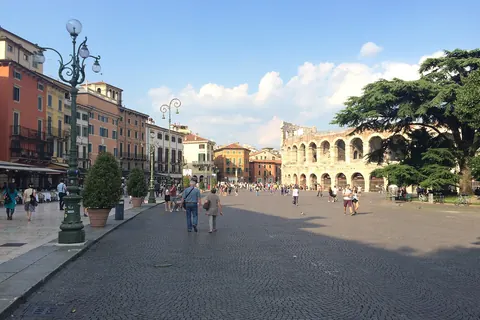
Piazza Bra, often simply called The Bra, is the largest public square in Verona, Italy, situated in its historic city center. The name "Bra" derives from a corruption of braida, a term rooted in the Lombardic word breit, meaning ’wide’ or ’broad’.
The open space of the Bra began transforming into a defined square in the early 16th century, when architect Michele Sanmicheli completed the Palazzo degli Honorij. This building delineated the western boundary of the future square and established a proper perspective toward the Verona Arena. The first effort to convert the unpaved expanse into a leisurely promenade came from podestà Alvise Mocenigo, who sought to create a gathering place for Verona’s emerging bourgeoisie. In 1770, he inaugurated the initial section of the Liston, a paved sidewalk flanking the Bra, linking Corso Porta Nuova to Via Mazzini. The Gran Guardia, begun by the Venetians in the 17th century and completed by the Austrians in the 19th century, defined the southern edge. In 1836, architect Giuseppe Barbieri designed the eastern boundary, where an old hospital, several houses, and a small church were demolished to make way for the Gran Guardia Nuova, now better known as Palazzo Barbieri. Initially used as an Austrian barracks, it became Verona’s municipal headquarters following the annexation of Veneto to the Kingdom of Italy.
Places in the district
- Verona Arena130 m
- Teatro Filarmonico240 m
- Arco dei Gavi330 m
- Porta Borsari340 m
- Castelvecchio Museum410 m
- Castelvecchio Bridge460 m
- Torre dei Lamberti610 m
- Scaliger Tombs710 m
Sources
Text: introduction of the Wikipedia article Piazza Bra, under the CC BY-SA 4.0 licence (authors: article history). Facts: Wikidata (CC0). Coordinates: Wikidata, map background © OpenStreetMap contributors.