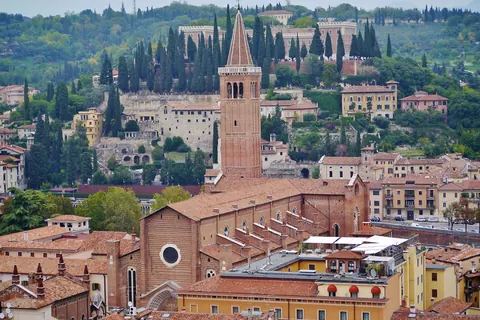
The church of San Pietro da Verona in Santa Anastasia, better known as the basilica of Santa Anastasia, is an important Catholic place of worship that stands in the heart of the historic center of Verona; it is located at the end of the decumanus maximus of the city in Roman times, near the point where the wide meander of the Adige river is crossed by the Ponte Pietra, where the two main traffic routes of the city, road and river, gravitate. It is the largest, most solemn and representative church in Verona, a reflection of a lively moment in the city’s life, when the expansion and consolidation of political and economic institutions allowed the community, in synergy with the Scaliger rule, the Dominican clergy and the Castelbarco family, to make a considerable financial effort to build this important temple, a symbol of their power.
The church represented the most important Gothic period for Verona. In the years immediately following its construction, it became a point of reference on which the designs of several other religious buildings were based, especially thanks to some innovations that St. Anastasia introduced into the plan, with the development of a wide transept and the articulation of the apsidal area into four chapels on either side of the presbytery, where the high altar is located, to the wall structure entirely in brick and to the new type of bell tower. The façade is unfinished, except for a majestic Gothic mullioned doorway that leads to a large interior divided into three naves by monumental cylindrical columns. On either side of the two naves are a series of chapels and numerous altars, the most famous of which is the Fregoso altar by Danese Cattaneo, praised by Giorgio Vasari. In addition, it is possible to admire paintings and frescoes by famous masters of Veronese painting and beyond, such as Pisanello, Altichiero, Liberale da Verona, Stefano da Zevio, Nicolò Giolfino, Giovan Francesco Caroto, Felice Brusasorzi, Francesco Morone, Michele da Verona and Lorenzo Veneziano.
Sources
- Wikipédia (fr) : Église Sainte-Anastasie de Vérone
- Wikipedia (en): Sant’Anastasia, Verona
- Wikidata: Q1056442
- Official website
Text: introduction of the Wikipedia article Sant'Anastasia, Verona, under the CC BY-SA 4.0 licence (authors: article history). Facts: Wikidata (CC0). Coordinates: Wikidata, map background © OpenStreetMap contributors.